
When your business continuity comes to a halt due to a cyber attack
For every business, everything revolves around continuity. Production orders must go out, customers must be delivered. What many companies only realise when it is too late: that continuity now depends as much on your IT infrastructure as on your resources. A hacked server, a blocked network, or lost data can halt production just as effectively as a broken machine — with the difference that in a cyber attack, you often do not know how long it will be down, and whether your data will return.
Printing International, a machine builder based in Flanders, took that reality seriously years ago. Under the impetus of CEO Filip Feyaerts, who has long considered cybersecurity a priority, the company opted for a structural approach instead of ad hoc, reactive measures. Fly By Wire has since provided the complete IT security of the company: from network to backup.
In this article, we explain what that approach looks like — not as an abstract concept, but as it is concretely applied at Printing International. Recognisable for any company that wonders whether its own IT security is up to scratch.
The basis: a network that offers resistance
Security does not start with software on a computer, but at the gateway through which all traffic enters: the network. At Printing International, Fly By Wire provides the routers, switches and firewalling that form and shield that network.
A correctly configured firewall filters malicious traffic before it ever reaches a workstation or server. It is the first — and often underestimated — line of defence. Many SMEs still work with outdated or standard-configured network equipment, which is precisely the easiest entry point for an attacker. At Printing International, that layer is actively managed and monitored, not just set up once and then forgotten.
In addition, Fly By Wire also provides the business wifi and the telephony (via 3CX), so that all network traffic — data and voice — runs through the same secure and managed infrastructure.
The second layer: endpoint management with SentinelOne
A firewall blocks a lot, but not everything. Malware can enter via a phishing email, a USB stick, or a vulnerability in software. That is why every computer and server at Printing International runs SentinelOne, an EDR solution (Endpoint Detection & Response) that not only blocks known viruses but also recognises suspicious behaviour — such as files suddenly being encrypted en masse, a classic sign of ransomware.
The difference with classic antivirus: SentinelOne looks at behaviour, not just at known "fingerprints" of malware. That is exactly what is needed against modern attacks, which are often specifically tailored and therefore not in a virus database.
SentinelOne is centrally rolled out and managed at Printing International via NinjaOne, the platform that Fly By Wire uses to monitor all devices remotely. That same monitoring is also used for a second, at least equally important task: patch management.
What is often overlooked: a large part of successful cyber attacks does not use advanced techniques, but rather a known, unpatched vulnerability in software that has been on the market for a long time. Every Microsoft application, as well as every third-party application — think of Adobe Reader, WinZip, and dozens of other programs that are used daily — can at any moment exhibit a weakness that only comes to light later. As long as that weakness is not patched, it effectively stands as an open backdoor.
Through NinjaOne, both the Microsoft applications and the third-party software at Printing International are continuously monitored and kept up to date. As soon as a vulnerability becomes known, the corresponding patch is rolled out as quickly as possible — without anyone at Printing International having to take action themselves. Endpoint management at Printing International is therefore twofold: SentinelOne actively detects and blocks malicious behaviour, while patch management via NinjaOne proactively closes the known weak spots.
The third layer: backup that survives what your network does not survive.
No security is watertight — and that is exactly why backup is not a "nice to have", but the last and most important safety net. At Printing International, this runs on two tracks:
- Cloud backup of servers and workstations. Critical data is not only stored locally, but is also kept off-site. If a server crashes, is encrypted by ransomware, or is physically damaged, there is a fully recoverable copy outside the company.
- Complete Microsoft 365 backup via NinjaOne. What many companies do not realise: Microsoft itself does not back up your mailbox, SharePoint or Teams files to the extent you would expect. A deleted email, a corrupted SharePoint folder, or an employee who accidentally (or maliciously) deletes files — without a separate backup, you lose that data. Through NinjaOne, the entire M365 environment of Printing International is kept separately and is recoverable.
That last point is a blind spot for many companies: they assume that "it is in the cloud" equates to "it is safe". That is a misconception.
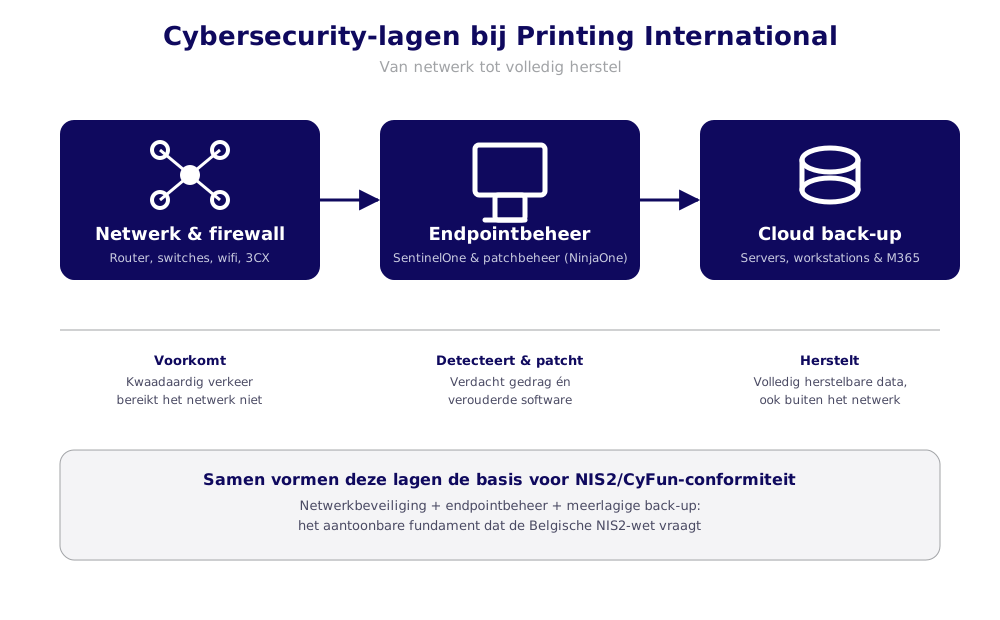
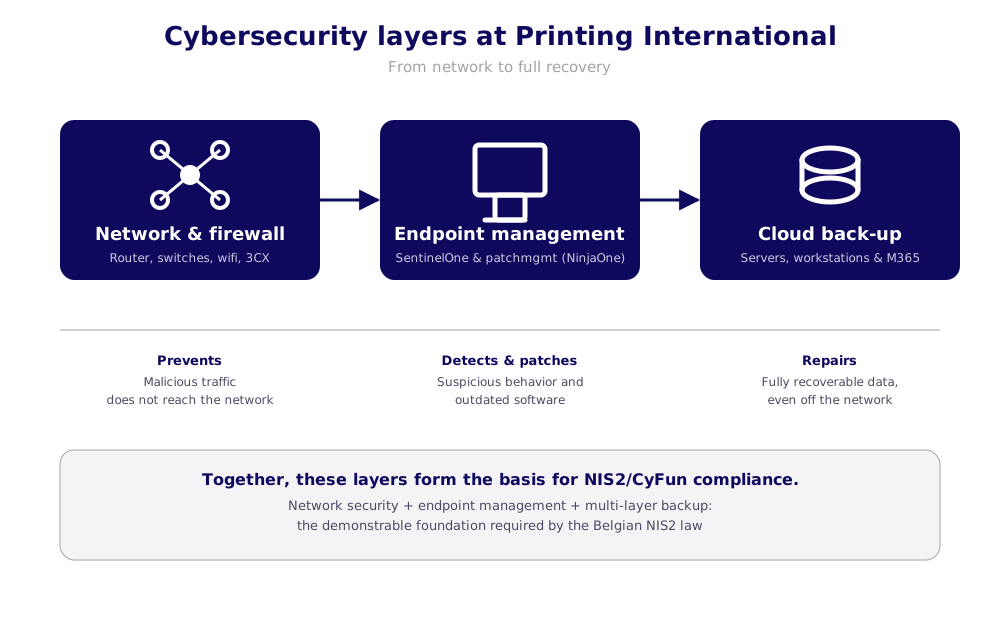
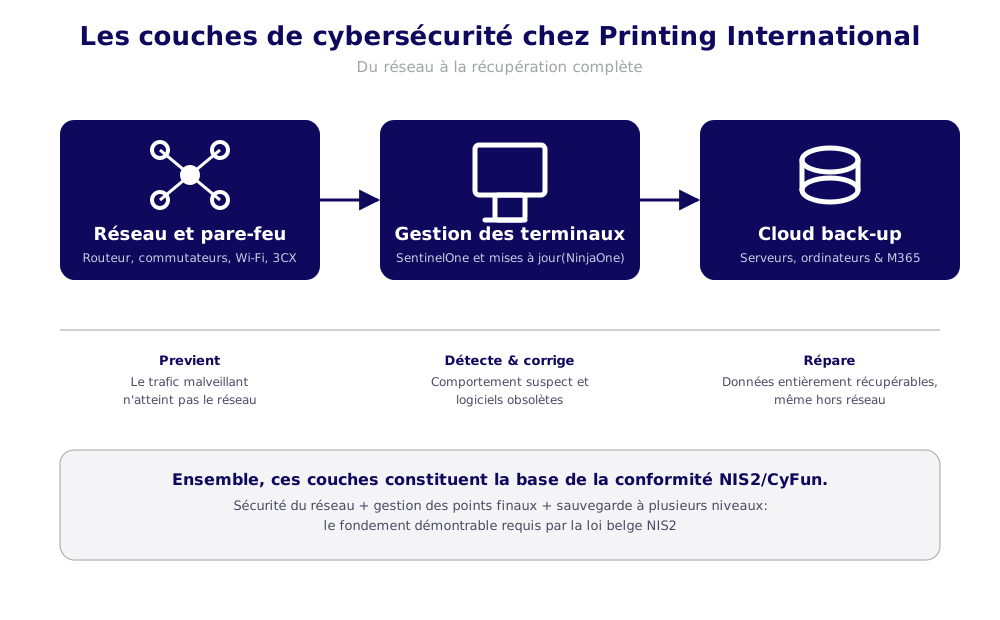
The diagram shows the three security layers: network & firewall, endpoint management (SentinelOne & patch management via NinjaOne), and cloud backup of servers and Microsoft 365.
What about NIS2?
Where cybersecurity used to be primarily an internal choice, it has now also become a legal obligation for many companies. The Belgian NIS2 law has been in effect since 18 October 2024, and the first major compliance deadline (18 April 2026) has since passed. The Centre for Cybersecurity Belgium (CCB) has been actively monitoring since then.
In summary: NIS2 requires a broad group of companies — depending on sector and size — to demonstrably work on their digital resilience. Not on paper, but in practice. Belgium is working with the CyberFundamentals (CyFun) framework, with increasing levels (Small, Basic, Important, Essential), which translates the legal requirements into concrete, verifiable measures. For SMEs, this is more accessible than an international standard like ISO 27001 — it is therefore the framework that most Belgian companies choose.
The stakes are high: in case of non-compliance, the CCB can impose administrative fines that can amount to 10 million euros or a percentage of the annual turnover, depending on the type of entity. Apart from fines, the risk of operational downtime and reputational damage weighs heavily.
Although Printing International does not fall directly under NIS2 based on the criteria, the NIS2 requirements also play an indirect role within the company through their customers. Fly By Wire supports them in this: the technical foundation described above — network security, endpoint management, backup — forms exactly the basis on which a CyFun-compliant security level is built.
Why Filip chooses a fixed IT partner
"As a technology company, we also want to look ahead in the field of IT and cybersecurity. A fixed IT partner knows our infrastructure, understands our needs, and can proactively advise on new risks and technological solutions. We find that expertise at Fly By Wire."

For every company, IT security is not a project that you complete once. It is an ongoing process of monitoring, updates, and adapting to new threats — and to new legislation such as NIS2. Filip Feyaerts consciously chose not to follow this up himself, but to outsource it to one fixed partner who manages the whole — network, telephony, endpoints, backup — in a cohesive manner, rather than having separate suppliers for each component.
The way of working is no coincidence. Fly By Wire is guided by an aviation background: precision, protocol, no shortcuts. In aviation, a checklist is only complete when each item has actually been checked — not when you "think" everything is fine. That same mentality translates to cybersecurity: no loose, ad-hoc measures, but structural layers that are each actively managed and monitored. For a company where downtime directly impacts costs and customer trust, that is precisely the difference between "we think it is fine" and "we know it is fine".
Frequently asked questions about cybersecurity
What is NIS2 and does my company need to comply?
NIS2 is a European directive, transposed into law in Belgium since 18 October 2024, which requires companies in a wide range of sectors to demonstrably work on their digital resilience. Whether your company falls under this depends on sector and size — the CCB offers a self-assessment tool for this. In doubt? Get in touch, we are happy to help.
Is cloud backup sufficient protection against ransomware?
Backup alone is not prevention — it is your safety net when prevention fails. A comprehensive approach combines network security and endpoint protection (to prevent or detect attacks early) with multi-layered backup (to recover quickly if things go wrong). One or the other alone is insufficient.
Does Microsoft 365 not back itself up automatically?
No — that is a common misconception. Microsoft stores data in the cloud, but does not provide a full, long-term backup solution for deleted or corrupted files, emails, or Teams data. A separate backup solution, such as through NinjaOne, is needed to keep that data truly recoverable.
Why is patching software so important for cybersecurity?
Many cyberattacks do not use unknown techniques, but rather known vulnerabilities in software that is not yet up-to-date — both in Microsoft applications and in third-party software such as Adobe Reader or WinZip. Without proactive patch management, such a backdoor remains open until someone exploits it.
How long does it take to recover data after a cyberattack?
That strongly depends on the scale of the incident and whether there are working backups available. With correctly configured and tested backups, recovery is usually a matter of days, not weeks — without a backup, data may sometimes be completely unrecoverable.
One point of contact, complete business continuity
What the approach at Printing International illustrates applies to every company: cybersecurity is not a matter of one tool or one measure, but of coherent layers — network, endpoints, patch management, backup — that are aligned with each other and actively managed. And with NIS2 gradually evolving from theory to practice, that coherence is not only wise but also necessary for many companies.
Fly By Wire has been the fixed IT partner of Printing International for years, with one contact person instead of a call centre, and a no-nonsense approach without unnecessary technical ballast.
Recognisable for your company?